Thursday, 4 December 2014

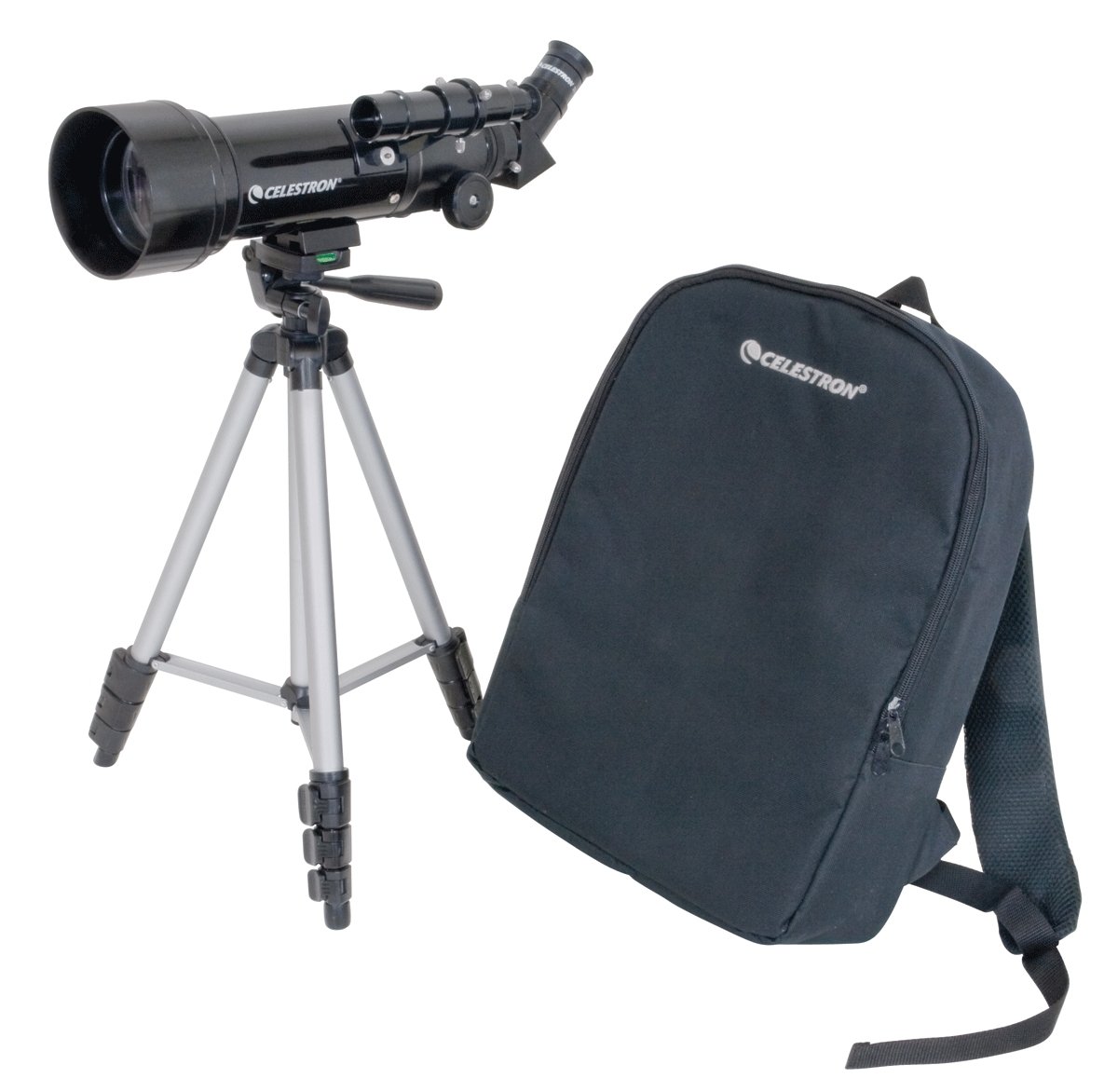
Celestron 21035 70mm Travel Scope


Technical Details

  • Brand Name: Celestron
  • Model: 21035

Product Description

Product Description

Travel Scope 70 was designed with traveling in mind. Highest quality materials used to ensure stability and durability. Minimal maintenance

The Celestron 21035 Travel Scope 70 is a compact 70mm refractor telescope optimized for portability and convenience. The telescope, the tripod, and all the accessories fit conveniently into a padded backpack style soft carrying case.

The complete accessory package includes a 45 degree correct image prism, a 20mm eyepiece for 20X magnification, and a 10mm eyepiece for 40X. The fully illustrated instruction manual is supplemented by a copy of "The Sky X" astronomy software that turns your PC into a virtual planetarium.

With a focal length of 400mm and a focal ratio of f/5.7, the Travel Scope 70 compares surprisingly well with popular f/5 "Short Tube 80" refractors but at a much lower cost. The Travel Scope 70 uses a number of plastic components to keep the cost and weight down, including a plastic focuser and plastic lens shade, but the all glass lenses deliver beautiful views of backyard birds during the daytime and lovely views of the Moon and stars at night.

The Travel Scope 70 offers daytime views that compare with more expensive spotting scopes. The 20mm eyepiece gives 20X magnification and a 2.5 degree field of view, with plenty of crisp detail when I’m looking at backyard birds.

The travel Scope 70 is also quick and easy to set up at night. The deep orange glow of the recent Lunar Eclipse was simply gorgeous, and I was even able to take some pictures using the Travel Scope 70 and a PowerShot camera.

When I look at Jupiter using the 10mm eyepiece (40X magnification) I can easily see four moons near the planet. And rich field views of the Milky Way are often at their best in a small scope with a wide field of view.
The tripod included with the Travel Scope 70 is described as a “full size photo tripod”, but I like it best as a table-top tripod with the legs kept short. The tripod is designed to be light and compact, but that means the legs are thin and wobbly when fully extended. --Jeff Phillips
Pros:
  • Light, portable, and affordable
  • Excellent wide field views
  • Padded backpack style case
  • High and low power eyepieces
  • The Sky X software included
Cons:
  • Light weight tripod
  • Plastic finder and focuser

Saturday, 24 December 2011

Investing in a Kids Telescope

If your youngster is showing interest in stargazing and astronomy, a kids telescope can get them started with their new hobby without a large investment.  Realize that a kids telescope is not a toy, but a fully functioning beginner telescope without all the advanced features. 

Giving your youngster a kids telescope will let them know that you support their interest in astronomy and see it as a worthwhile endeavor.   A real telescope, even without all the features, can give your child or grandchild a head start in learning about the universe and star systems. 

Investing in a Kids Telescope

While you can purchase a child telescope for under $25, these are really more of a toy than a functioning astronomy telescope.  A real basic beginner telescope can be purchased for around $100 and can provide the young astronomer with a gateway to the heavens.  If you wish to invest a little more, a good starter telescope with some of the more advanced features, will cost anywhere from $200 to $300.  This will provide your youngster with a quality piece of stargazing equipment.

As the child’s interest grows, an investment in a more sophisticated telescope model might be appropriate.  For instance, many young astronomers enjoy having the capability to photograph certain star formations or passing comets.  

Tips for Buying the Right Child Telescope
Many astronomers and educators recommend a telescope with a longer focal length and separate viewer.  This allows the child to find objects much easier and reduces the frustration that can result for the novice astronomer.  

There are many cheaper models that offer a focal length of only 30mm or 50mm and will provide a more generalized view of the night sky.  However, if you want a telescope that will provide a more detailed picture of the planets, moon and constellations, a 70mm or higher focal length is strongly recommended.
    
Kids telescopes are available from a number of top-rate optics companies like Meade, Celestron, Bushnell, Orion and many others.  Even the Discovery Channel offers an affordable 70mm lens kids telescope with easy set-up and easy-to-use features.  

Meade provides some of the best telescopes on the market today and caters to the amateur astronomer – from beginner to expert levels.  For example, a 1000mm focal length telescope with photographic capabilities can be purchased for about $150.  This is an excellent choice for the new astronomer because it provides a very good view of the heavens and shows details of the planets and moon that are generally not found with a telescope in this price range.  An added bonus is that a 35mm camera can be attached to this telescope that allows your child to preserve those special night sky views on film.

How to Use a Kids Telescope
Reading the instructions for your child’s new telescope can’t be stressed enough.  Even the basic kids’ telescopes can be confusing to use the first few times.  It is advisable for the parent to read through the instruction manual and help the child astronomer learn the basics of the telescope’s operating features.

A great way to enhance your child’s interest in astronomy is to view the night skies together.  There is no better way to bond with your child than by enjoying the same hobbies and actively pursuing them together. 

A kids telescope can open up a whole new exciting world to your youngster.  It can broaden their understanding of the universe and allow them to be a part of the cosmos beyond just this planet.  Why not invest in your child by getting them a kids telescope for fun, education, and a true bonding experience.

Friday, 23 December 2011

Astronomy Without The Hubble?

The microscope and telescope are two of the most potent symbols of science. The most important factors in a telescope are the aperture, (or light gathering capability), and the quality and accuracy of their optics. The major design criteria for a new telescope are portability and low cost. What type of telescope are you interested in? Among the many kinds of telescope, the reflecting and refracting telescope are two of the most popular. And, aperture and quality in a telescope are worth much more than power any day. Be sure and spend some time looking around and talking to other star gazers to get some ideas of what would suit you. Most observers would be happy to advise you. For more information please go to http://www.yesastronomy.com.

Maybe something like a Hubble Space model would suit you? Maybe you can make a deal on a slightly used version? Well, maybe not, but here are some interesting facts about the Hubble.

The Hubble Space Telescope has dazzled us with its astonishing images and discoveries. The Hubble Space Telescope has taken about 750,000 images in is 16+ years in space. It was deployed on April 25, 1990, and is actually a giant observatory aboard a spacecraft. Astronomers using the Hubble Space Telescope are at the dawn of a new era in exploring the universe as it whirls around Earth at a speed of 5 miles per second.

Hubble's images are processed by the Space Telescope Science Institute (STScI). The Hubble Space Telescope (HST) was the first and flagship mission of NASA's Great Observatories program. It truly is a national asset. But, there have been issues: he Hubble Space Telescope was placed in orbit in April 1990 and in June that year scientists discovered a problem with its primary mirror. That problem was soon fixed but Hubble has had numerous problems throughout its life.

But the Hubble Space Telescope, which opened Earth's eyes to an awe-inspiring universe of star births and colliding galaxies, is far from being in the junk pile. In fact, it has gotten several extensions on its warranty. NASA has sent various missions to the Telescope to conduct repairs and upgrades. And, future improvements to the Hubble Space Telescope are in the works.

Although the Hubble Space Telescope has been operating continuously since 1990, there are plans in the works to replace it. It has given astronomers and amateurs alike a multitude of thrills in its life, and more are on the way. But, like all good things, it's life will end. But fear not...something better is on the way.

Thursday, 22 December 2011

Useful Tips For Starting Astronomy

When you are thinking about astronomy, the first thing that comes to mind is a telescope. This misconception is found every day. Actually, the first thing you need to do is look at the stars with a pair of binoculars. You cam spend hundreds of dollars on a telescope that might not be the right one. One thing that star glazers will tell you is that some of the lunar eclipses and bright comets look better with binoculars than with a high-powered telescope.

You need to look around the sky with a star map and learn about the stars and other objects in space before you jump in and buy a telescope. Sometimes what you see through a telescope will be ugly, where as through the binoculars, it is a beautiful focused site to see. Once you learn about the stars themselves, you will have a better understanding of what you are looking at and how far away it really is.

After you learn about the sky above you are ready to look for a telescope. Before rushing out and buying a telescope, you should find some astronomers who will share their experiences and maybe even their telescopes with a group. Trying out a telescope before you buy it is something that will help you decide on what telescope will be best for you.

Some things to consider are what you plan to do with the telescope, how much you have to spend and are you going to take photographs of your sightings. If you are a causal backyard astronomer, you might even look at the Dobsonian telescopes. Never worry about power, but be more concerned about aperture and optics. If you will be viewing planets, you will need a telescope with high magnification. You would not want to buy a telescope with 600 power, as it will not have the aperture needed.

Most professional astronomers use a reflector type of telescope. This is where the light path is diverted to the concave lens or eyepiece. With the refractor telescopes, the light passes through the telescope by way of a lens to the eyepiece. In some of the opinions from astronomers, the refractor is the best type of telescope for looking at the solar system. However, reflectors are cheaper than the refractors. Reflector telescopes are recommended for beginning astronomers.

You will find areas with complete darkness are the best, but city viewing is fine if you have very little light to distract your viewing. Keep in mind that planet viewing is spectacular. You can see the ring around Saturn as well as view Venus. Jupiter, which changes every time you view it, is an amazing planet to keep an eye on.

You will want to have a star map, planet map and keep an eye on the news to find out when any interesting things are appearing in the solar system. Experience the sighting of a comet or meter shower, you will find that astronomy is a great way to spend the evening by yourself or with friends.

Wednesday, 21 December 2011

The Milky Way is 14 Billion Years Old

No matter how far along you are in your sophistication as an amateur astronomer, there is always one fundamental moment that we all go back to.  That is that very first moment that we went out where you could really see the cosmos well and you took in the night sky.  For city dwellers, this is a revelation as profound as if we discovered aliens living among us.  Most of us have no idea the vast panorama of lights that dot a clear night sky when there are no city lights to interfere with the view.

Sure we all love the enhanced experience of studying the sky using binoculars and various sizes and powers of telescopes.  But I bet you can remember as a child that very first time you saw the fully displayed clear night sky with all the amazing constellations, meters and comets moving about and an exposure of dots of light far to numerous to ever count.

The best way to recapture the wonder of that moment is to go out in the country with a child of your own or one who has never had this experience and be there at that moment when they gaze up and say that very powerful word that is the only one that can summarize the feelings they are having viewing that magnificent sky.  That word is – “Wow”.

Probably the most phenomenal fact about what that child is looking at that is also the thing that is most difficult for them to grasp is the sheer enormity of what is above them and what it represents.  The very fact that almost certainly, virtually every dot up there in the sky is another star or celestial body that is vastly larger that Earth itself, not by twice or ten times but by factors of hundreds and thousands, can be a mind blowing idea to kids.  Children have enough trouble imagining the size of earth itself, much less something on such a grand scope as outer space.

But when it comes to astronomy, we do better when we fall into deeper and deeper levels of awe at what we see up there in the night sky.  Some amazing facts about what the children are looking at can add to the goose bumps they are already having as they gaze eyes skyward.  Facts like…

*    Our sun is part of a huge galaxy called the Milky Way that consists of one hundred billion stars just like it or larger.  Show them that one hundred billion is 100,000,000,000 and you will se some jaws drop for sure.

*    The milky was is just one of tens of billions of galaxies each of which has billions of stars in them as well.  In fact, the Milky Way is one of the small galaxies.

*    If you wanted to drive across the Milky Way, it would take you 100,000 years.  But you can’t get there driving the speed limit.  You have to drive five trillion, eight hundred million miles per year to get all the way across that fast.

*    Scientists calculate that the Milky Way is 14 billion years old.

These little fun facts should get a pretty spirited discussion going about the origins of the universe and about the possibility of space travel or if there are life on other planets.  You can challenge the kids to calculate that if every star in the Milky Way supported nine planets and if only one of them was habitable like earth is, what are the odds that life would exist on one of them?  I think you will see some genuine excitement when they try to run those numbers.

Such discussion can be fun, exciting, and full of questions.  Don’t be too hasty to shut down their imaginations as this is the birth of a lifelong love of astronomy that they are experiencing.  And if you were there that first moment when they saw that night sky, you will re-experience your own great moment when you was a child.  And it might set off a whole new excitement about astronomy in you all over again.


Tuesday, 20 December 2011

The Glossary of Telescopes

When you enter into any new area of science, you almost always find yourself with a baffling new language of technical terms to learn before you can converse with the experts.  This is certainly true in astronomy both in terms of terms that refer to the cosmos and terms that describe the tools of the trade, the most prevalent being the telescope.  So to get us off of first base, let’s define some of the key terms that pertain to telescopes to help you be able to talk to them more intelligently. 

The first area of specialization in telescopes has to do with the types of telescopes people use.  The three designs of telescopes that most people use are the Refractor, the Reflector and the Schmidt Cassegrain telescope. 

*    The refractor telescope uses a convex lens to focus the light on the eyepiece. 

*    The reflector telescope has a concave lens which means it bends in.  It uses mirrors to focus the image that you eventually see. 

*    The Schmidt Cassegrain telescope uses an involved system of mirrors to capture the image you want to see.

*    A binocular telescope uses a set of telescopes mounted and synchronized so your view of the sky is 3-D.

Beyond the basic types, other terms refer to parts of the telescope or to the science behind how telescopes work.

*    Collimation is a term for how well tuned the telescope is to give you a good clear image of what you are looking at.  You want your telescope to have good collimation so you are not getting a false image of the celestial body.

*    Aperture is a fancy word for how big the lens of your telescope is.  But it’s an important word because the aperture of the lens is the key to how powerful your telescope is.  Magnification has nothing to do with it, its all in the aperture.

*    Focuser is the housing that keeps the eyepiece of the telescope, or what you will look through, in place.  The focuser has to be stable and in good repair for you to have an image you can rely on.

*    Mount and Wedge.  Both of these terms refer to the tripod your telescope sits on.  The mount is the actual tripod and the wedge is the device that lets you attach the telescope to the mount.  The mount and the wedge are there to assist you with a superior viewing session and to keep your expensive telescope safe from a fall.

*    An Altazimuth Mount refers to the tripod of the telescope that holds the device in place and makes it useful during a star gazing session.  The altazimuth mouth allows the telescope to move both horizontally (which is the azimuth) and vertically.  In this way you have full range to look at things close to the horizon or directly overhead.

*    Coma has a different meaning than the one we are used to, and that’s a good thing.  The coma is the blurry area on the outer rims of your view through the telescope.  How big the coma is and to what extent it interferes with your viewing will have is important to the effectiveness of your telesscope.

*    Planisphere.  A fancy word for a star chart.  It is nothing less or more than a detailed map of where everything is in the cosmos and how to find the star you wish to study by keying off of known stars.

*    Barlow.  This refers to a specialized type of lens that you can buy to enhance the magnification of your telescope. 

These are just a few of the basic concepts of telescope operation.  We deliberately picked the ones you have to know to discuss telescopes intelligently.  But your education into the more complex aspects of astronomy and telescope design and operation will go on for as long as you are a lover of astronomy, which we hope is for the rest of your life.


Monday, 19 December 2011

The Amazing Hubble

In the history of modern astronomy, there is probably no one greater leap forward than the building and launch of the space telescope known as the Hubble.  While NASA has had many ups and downs, the launch and continued operation of the Hubble space telescope probably ranks next to the moon landings and the development of the Space Shuttle as one of the greatest space exploration accomplishments of the last hundred years.

An amazing piece of astronomy trivia that few people know is that in truth, only about ten percent of the universe is visible using conventional methods of observation.  For that reason, the Hubble really was a huge leap forward.  That is for the very simple reason that the Hubble can operate outside of the atmosphere of Earth.  Trying to make significant space exploration via telescopes from the terrestrial surface of planet Earth is very difficult.  That very thing that keeps us alive, our own Earth’s atmosphere presents a serious distraction from being able to see deeper and further into space.

The Hubble space telescope was named after the great scientist and visionary Edward Hubble who discovered that the universe was expanding which was explained by what is now known in science as Hubble’s Law.  To truly get a feel for the amazing accomplishment that was achieved with the launch of the Hubble telescope, spend some time on Nasa’s web site dedicated to the project at http://hubble.nasa.gov.  There are also a number of sites where you can enjoy some stunning pictures from the Hubble including http://heritage.stsci.edu/ and http://www.stsci.edu/ftp/science/hdf/hdf.html.

It’s hard to believe how long the Hubble has been orbiting earth and sending back amazing video and pictures of what it is discovering in space.  But the Hubble was actually initially launched on April 25th 1990.  It was the culmination of literally decades of research and construction which began in 1977.  Expectations were high as the orbiting telescope was put in place and actually began to function as it was designed to do.

All was not always perfect with the telescope and the early pictures were disappointing.  After some study NASA discovered that the reason for the early failures was the curvatures of one of the main lenses of the orbiting telescope.

We probably could never have kept this intricate piece of equipment operational as well as we have had we not had the Space Shuttle program to give us a tool to implement repairs and improvements to the Hubble.  In 1993 a new lens was installed on the Hubble which corrected the problem of picture resolution that was noted in the early operation of the telescope.

Two other repair and upgrade mission have been made to the Hubble since it launched, both of them in 1997 to upgrade older equipment and to retrofit the telescope to extend its useful life through 2010.  It’s pretty amazing to think that this scientific and mechanical marvel has been operating now for ten years without maintenance.  We can be assured that plans are in the works for NASA to upgrade or replace parts on the Hubble to extend its useful life even further as that 2010 time frame draws closer. 

It is hard to imagine the science of astronomy or the natural quest for greater knowledge of our universe without the Hubble.  While many times those who would not fund space exploration have tried to cut funding for the Hubble, the operation of this telescope is just too important to astronomers and to the scientific well being of mankind and our planet not to continue to use the Hubble, or its next natural successor.  We will always need to have a set of eyes in the sky to watch the universe and discover more of its mysteries.a